What is Dewatering?
Dewatering is the process of removing excess water from soil, slurry, sludge, or mineral material to prevent work from stopping. Too much water makes material heavy, unstable, and difficult to manage. Because of this, dewatering techniques are used as a routine step in mining, construction, wastewater treatment, dredging, and industrial processing. When water is not controlled, projects face delays, higher handling costs, and safety risks on site.
In mining work, dewatering is mainly used to control tailings and limit storage volume. On construction sites, it is used to keep excavations usable and prevent collapse. In wastewater and industrial slurry handling, it helps improve processing and reduces disposal loads. The purpose is practical rather than technical: remove water so operations can continue without disruption.
Most projects do not rely on one universal solution. Instead, three approaches are commonly used depending on site conditions. These include filtration, pumping, and gravity separation. Each approach behaves differently in terms of speed, dryness of solids, and system effort. Understanding these differences helps teams choose a method based on site reality, not habit.
Why this comparison matters
In many projects, dewatering techniques are mentioned without much explanation. Equipment is selected because it has been used before, not because it fits the actual slurry or site conditions. This often leads to avoidable problems later, such as poor solids handling, higher operating effort, or systems that do not perform as expected once work starts.
Different sites behave differently. Slurry properties change. Space is limited. Timelines shift. When these factors are ignored, even well-known systems can struggle. Comparing filtration, pumping, and gravity separation helps avoid this trial-and-error approach and makes selection more practical.
This comparison is meant to support real decisions on site. It focuses on how material type, operating constraints, and performance needs influence which method works better in practice. By looking at these approaches side by side, engineers and project teams can choose a method based on conditions, not assumptions.
About Pump and Slurry
Pump and Slurry focuses on solving on-site dewatering problems rather than selling a standard system. The approach starts with understanding actual slurry conditions, which often change during operation and rarely behave as planned.
The company has supported dewatering work in mining, construction, wastewater, and industrial environments where abrasion, variable solids, and space limits are common. These conditions shape how equipment is selected and applied.
Instead of relying on one method, Pump and Slurry works with different dewatering techniques, including pumping, filtration methods, and gravity separation, often using more than one approach on the same project. The aim is simple: equipment that works reliably on site and remains manageable over time.
The Science Behind Dewatering Techniques
Understanding the physics
Every dewatering process is governed by basic physical properties of the slurry or material being treated. Key factors include solids concentration, particle size distribution, particle shape, density, viscosity of the liquid phase, and settling velocity. Together, these parameters determine how easily water can be separated from solids.
Filtration relies on pressure or vacuum to force water through a permeable barrier while solids are retained. Pumping depends on hydraulic energy to move water or slurry from one location to another. Gravity separation uses natural settling driven by density differences between solids and liquid.
Fluid dynamics plays a role in all three methods. Flow velocity, turbulence, and shear influence how particles behave during transport or separation. Gravity provides the driving force in passive systems, while mechanical energy dominates in filtration and pumping systems.
When the mechanism determines success
The composition of the slurry largely dictates which approach will succeed. Coarse, fast-settling particles respond well to gravity-based systems. Fine particles with slow settling rates often require filtration methods or chemical conditioning. Highly abrasive slurries may favor robust pumping solutions that prioritize transport rather than separation.
Performance is typically measured by throughput, dryness of the final solids, power consumption, and maintenance demand. No single approach optimizes all metrics simultaneously. Effective dewatering techniques balance these drivers in line with project priorities.
Dewatering by Filtration: Mechanisms, Methods, and Use Cases
What is filtration in dewatering?
Filtration is a mechanical separation process in which a liquid is forced through a permeable medium while solids are retained. The medium may be a cloth, a screen, or a membrane, depending on the system design. Pressure filtration and vacuum-assisted systems are the most common configurations.
In pressure filtration, mechanical force compresses the slurry against the filter media. In vacuum systems, negative pressure draws liquid through the media while solids accumulate on the surface as a filter cake.
Common filtration methods
-
Filter presses
Plate-and-frame and membrane filter presses are widely used where high-solids dryness is required. Slurry is pumped into closed chambers where pressure builds, and water exits through filter cloths. The result is a compact, stackable solids cake.
-
Belt filters
Belt filters provide continuous operation by combining gravity drainage with mechanical compression. Slurry is distributed across a moving belt, allowing water to drain before the material passes through compression zones.
-
Rotary vacuum drum filters
These systems rotate a partially submerged drum covered in filter media. Vacuum draws liquid through the media while solids form a cake on the drum surface. Cake thickness and moisture content can be adjusted by operating parameters.
Across these systems, filtration methods are valued for their ability to achieve relatively dry solids compared to other approaches.
When filtration excels
Filtration performs best when the slurry contains a high solids concentration with a predictable particle size range. It is commonly applied in mining tailings management, mineral processing, and industrial sludge treatment. When disposal costs are tied to moisture content, filtration methods offer clear economic advantages.
Limitations and operational challenges
Filtration systems involve greater mechanical complexity and higher capital costs than gravity systems. Fine particles often require chemical conditioning to improve performance. Maintenance demands are also higher due to moving parts and wear surfaces.
Dewatering by Pumping: Techniques, Equipment, and Performance Criteria
Pumping as a dewatering technique
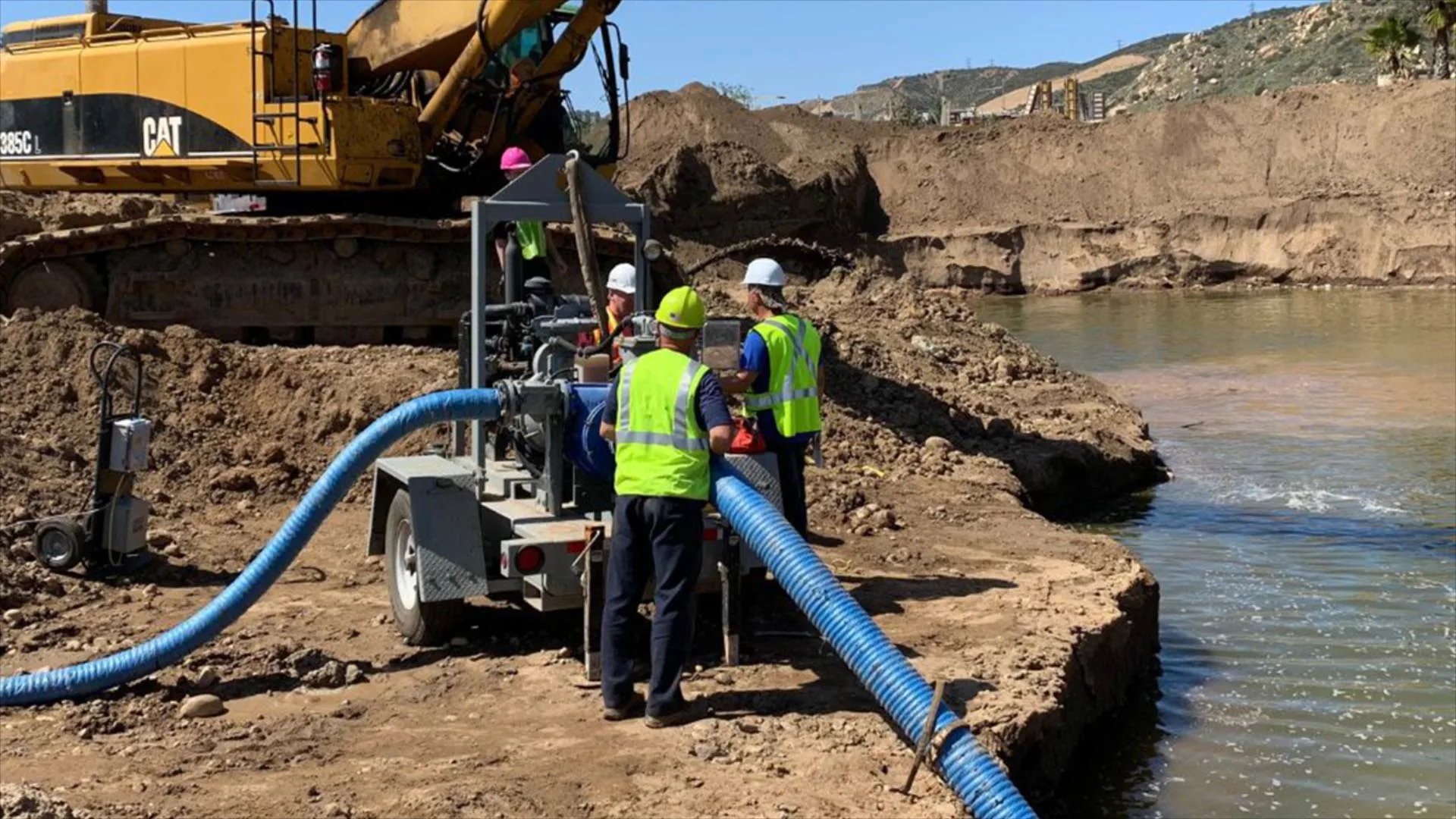
Pumping removes water or slurry from a location to allow work to continue. It does not separate solids from water. The main purpose is to clear water quickly from excavations, pits, or low areas. Among dewatering techniques, pumping is used most often because it is fast and easy to deploy on site.
Types of pumps used in dewatering
-
Submersible dewatering and slurry pumps
These pumps are designed to operate underwater. They are commonly used in sumps, pits, and flooded excavation areas where access is limited.
-
Centrifugal pumps
Centrifugal pumps are used where high flow rates are required. They are common in construction drainage and slurry transfer applications.
-
Trash and high solids pumps
These pumps have larger internal clearances. They can pass debris without clogging, which makes them suitable for construction and municipal work.
-
Positive displacement and diaphragm pumps
These are used when the slurry is thick or contains solids that are difficult to handle with centrifugal pumps.
Strategic pumping deployment
Pumping is central to excavation dewatering, quarry drainage, and emergency flood control. It is also used to move slurry toward filtration units or gravity separation areas. Pump and Slurry applies practical selection methods to match pump type, materials, and capacity to abrasive and changing slurry conditions.
Benefits and practical considerations
Pumping allows quick water removal and provides flexibility as site conditions change. Equipment can be relocated easily. However, pumping alone does not separate solids, which is why it is often combined with filtration methods or gravity separation in larger systems.
Dewatering by Gravity Separation: Principles and Best Applications
What is Gravity Separation?
Gravity separation is one of the most basic dewatering techniques. It works by allowing solids to settle naturally when slurry or water is left undisturbed. Heavier particles sink to the bottom, while clearer water remains on top and can be removed. No mechanical force is applied during this process.
Unlike filtration methods or pumping systems, gravity separation relies only on time and particle weight. Because of this, it is usually used as a supporting or early-stage method rather than a complete solution for demanding projects.
Natural versus Engineered Gravity Methods
Natural gravity systems include settlement ponds, basins, and sumps. These systems hold water long enough for solids to settle and are commonly used on construction sites and agricultural projects where space is available.
Engineered gravity systems are designed to improve settling performance. These include lined basins, dewatering beds, and systems with underdrains or geotextiles. They reduce settling time and improve solids capture, especially when combined with mild chemical treatment.
In wastewater facilities, gravity separation is often the first step before filtration methods or mechanical thickening. In mining and dredging, it helps reduce the load on pumping and filtration equipment.
When Gravity Separation Works Best
Gravity separation performs best when particles are coarse, dense, and settle quickly. It is suitable for projects where water removal does not need to happen immediately. Agricultural runoff management, small earthworks, and early-stage wastewater treatment commonly rely on gravity separation.
Projects with low operating budgets and sufficient space often prefer gravity separation because of its low energy use and minimal equipment needs.
Practical Limits of Gravity-Based Dewatering
Gravity separation has clear limits. Fine particles can remain suspended for long periods and may not settle adequately. Space availability, weather conditions, and discharge regulations can also restrict its use. For projects that require fast turnaround or high water clarity, gravity separation alone is usually not sufficient.
Side-by-Side Comparison: Filtration vs Pumping vs Gravity
| Criteria | Filtration | Pumping | Gravity Separation |
| Mechanism | Mechanical cake formation | Hydraulic transport | Passive settling |
| Typical output | Dry solids cake | Transported slurry or water | Settled solids over time |
| Speed | Moderate to slow | Fastest | Slowest |
| Equipment cost | High | Medium to variable | Low |
| Best for | High solids content | High flow removal | Low urgency projects |
| Maintenance | Mechanical wear | Pump wear and seals | Minimal |
This comparison highlights how different dewatering techniques serve distinct operational needs.
Choosing the Right Dewatering Strategy: Decision Framework
Selecting among dewatering techniques should be based on site conditions rather than habit or past preference. Projects that perform well usually assess several practical factors before choosing between filtration methods, pumping systems, or gravity separation. A structured approach helps avoid underperforming setups and repeated adjustments during operation.
Slurry Characteristics
The physical nature of the slurry is the first factor to consider. Slurries with high solids concentration or fine particles often require filtration methods to achieve effective water removal. Abrasive or inconsistent slurries may be better handled through pumping, where durability and continuous flow are more important. Coarse materials that settle predictably can often be managed using gravity separation, especially as an initial stage.
Project Timeline and Scale
Time pressure strongly influences method selection. Emergency situations, deep excavations, and high inflow conditions usually rely on pumping due to its speed and flexibility. Long-term operations with stable flow volumes may justify the use of filtration systems, as they yield drier solids and reduce disposal costs over time.
Site and Environmental Constraints
Available space, access to power, noise limits, and discharge regulations all affect dewatering choices. Urban sites often lack room for gravity separation systems, which pushes projects toward compact pumping or filtration units. In rural or remote locations, gravity separation combined with mobile pumping may be more practical.
Cost and Operational Balance
Short-term projects often prioritize quick setup and mobility, while long-term facilities focus on reliability and lifecycle cost. The most effective dewatering techniques balance capital investment, operating effort, and performance instead of focusing on a single advantage.
Why Pump and Slurry is the Trusted Choice for Dewatering Solutions
Pump and Slurry focuses on solving practical dewatering problems rather than offering standard packages. Each project is approached by first understanding site conditions, slurry behavior, and operating limits before recommending a system. This reduces the risk of selecting equipment that performs well on paper but struggles in real use.
The company supports a wide range of dewatering techniques, including pumping systems that work alongside filtration methods and gravity separation. This flexibility allows systems to be adapted as conditions change during a project, rather than forcing a single method to fit every situation.
-
Industry Experience That Translates to Results
Experience across mining, construction, wastewater, and industrial sectors allows Pump and Slurry to anticipate common site challenges. This background helps avoid undersized equipment, excessive wear, and unexpected downtime during operation.
-
Tailored System Design
Projects differ in material type, flow rates, and space limits. Pump and Slurry designs systems that match these conditions, combining equipment and operating parameters to achieve stable performance over time.
-
Reliability in Demanding Conditions
Dewatering environments are often abrasive and unpredictable. Equipment must handle variable solids content and continuous operation. Pump and Slurry emphasizes durable designs and practical material selection to maintain reliability.
-
Technical Support Beyond Equipment Supply
Support extends beyond equipment delivery. Guidance is provided for sizing, installation, operation, and maintenance, allowing adjustments as site conditions evolve.
Case Studies
-
High Volume Excavation Dewatering
A large excavation project experienced continuous groundwater inflow during periods of heavy rain. Submersible pumps were used to lower water levels quickly and keep the work area accessible. Gravity separation basins were then used to reduce suspended solids before discharge. This approach allowed the project to meet discharge requirements while maintaining safe working conditions.
-
Mining Tailings Dewatering
A mining operation needed to reduce moisture content in tailings to limit storage volume. Filtration methods using filter presses produced compact solids cakes suitable for handling and disposal. Pumping systems were used to move slurry between processing stages, allowing consistent flow without interruption.
-
Wastewater Sludge Handling
A municipal wastewater facility used a staged dewatering approach. Gravity separation was applied first to thicken incoming sludge. Filtration methods were then used to further reduce the moisture content, and pumps transferred the material to the final treatment areas. This sequence reduced energy use while maintaining steady performance.
Practical Takeaways for Effective Dewatering System Design
Filtration, pumping, and gravity separation each play a different role within modern dewatering techniques. Filtration methods are used when dryness is important, and disposal volumes need to be reduced. Pumping is relied on for speed, flexibility, and control, especially in changing site conditions. Gravity separation supports dewatering where time and space are available, and operating costs need to remain low.
In practice, the most effective systems do not rely on a single method. Dewatering techniques are often combined and applied at different stages based on slurry behavior, project timelines, and site constraints. Choosing the right approach at each stage reduces operational issues and improves overall efficiency.
For operators looking for dependable guidance and equipment, Pump and Slurry provides experience-based support grounded in real site conditions. By aligning dewatering techniques with how materials behave in the field, projects can operate more reliably and with fewer disruptions.